Pedagogy of landscape
Originally intended as a reflection on architectural workshop, this essay evolved into a phenomenological exploration of how we perceive and inhabit the land. It examines the landscape not just as a visual backdrop, but as an active teacher that shapes our spatial awareness. By blending on-site observations with broader theoretical inquiries, the text offers a grounded, reflective look at the deep dialogue between a human, material environments, and ecological systems.
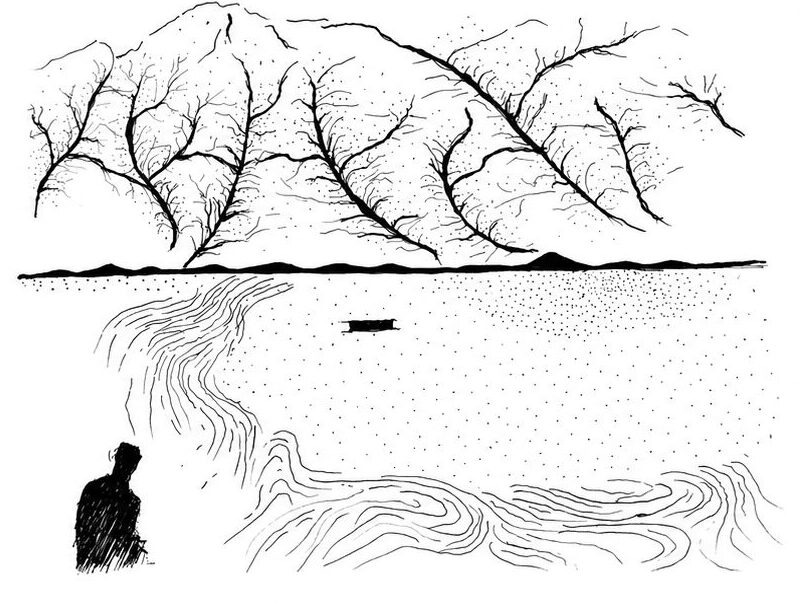
For some time now, I have been resisting the cold current of water rising from the depths of the lake. With my legs I try to push away the unsettling forces surrounding my body, yet the water persists without mercy. My heartbeat accelerates, and a hazy cloud settles in my mind. Shimmering waves reflect the strong sun, and in the distance the wind moves the branches of trees. Then I open my eyes wide and look into the clear sky. I see a bird flying high and freely above the mountains. It follows the rhythm dictated by nature. The bird and nature are inseparably connected. I forget myself. I surrender. I slow my movement, breathe deeply, and give myself over to the cold current that winds from the darkness deep beneath me. Only now do I truly sense where I am. In the middle of a lake that is merely a remnant of a former glacier. On all sides I am surrounded by vertical mountain walls whose forces I feel deep within my body. I become aware of my own smallness and at the same time the overwhelming power of the landscape around me. I feel the weight of the glacier that once shaped this valley, and I wonder: am I in its way? Or am I something completely invisible to it?
Contemporary architecture is often born in a rapid rhythm within sterile office environments, at rectangular desks, on printed site plans, or even at the safe distance of computer screens. Through photographs, drawings, digital models, and artificial intelligence, we increasingly experience space through its images and representations. While these allow ever more precise analysis and planning, they simultaneously create a distance from direct, bodily understanding of space. The moment a space becomes merely data, we forget how air temperature changes within it, how the shadow of a tree canopy forms patterns on the grass, how damp wood smells, how rough the texture of concrete is, and ultimately how we perceive ourselves within that space.
Through reflection and a retrospective of an architectural workshop in Bohinj, this text opens a discussion on how crucial sensory and bodily perception of space is, how architecture can be thought and designed within space itself, and what it truly means to become aware of the environment that surrounds us. In doing so, a contrast inevitably emerges between classical architectural education, grounded in visual distance, speed of production, and a defined process, and, on the other hand, studying within space, which demands time, presence, and above all humility.
Immersion in the landscape became the key to a week-long stay and educational experience in Bohinj. As part of the architectural workshop Lake/Island, under the mentorship of Australian architect Peter Stutchbury and Professor Maruša Zorec, we engaged with the landscape of a glacial valley—admiring it, studying it, and above all thinking about it and repeatedly interpreting it. Time slowed down. We listened to the landscape, to architecture, to people, and to processes that were perhaps invisible to the eye. Our experience and thinking about space were not confined to architecture alone but exceeded the boundaries of built space and at moments even the limits of human action. The landscape continually told us stories, opened questions, and sometimes quietly answered them.
David W. Orr, in Earth in Mind, notes that contemporary education emphasizes theories, abstraction, formulated answers, and technical proficiency rather than principles, awareness, questions, and consciousness. The same could be said today of architectural education. It is often defined as a completed answer to a task—a carefully designed building, a refined interior, or a closed theory. Architectural education frequently becomes a static intellectual construct that loses contact with unpredictability, spontaneity, curiosity, and the primordial nature of both human beings and nature itself. To escape such rigidity, it is necessary to consciously transform how we understand the educational process. According to Orr, the study of place requires a complementary dimension of intellect—one that unites observation, exploration, experimentation, and ultimately the ability to apply acquired knowledge.
Now, days later, sitting on an old wooden bench by the lake, I reflect and ask myself what that primordial architectural education truly is, and whether an architectural creation can hold the power to generate an experience in which human and nature become one. Can a human-made structure transcend its physical form and become a medium through which we rediscover our deepest connection to the world?
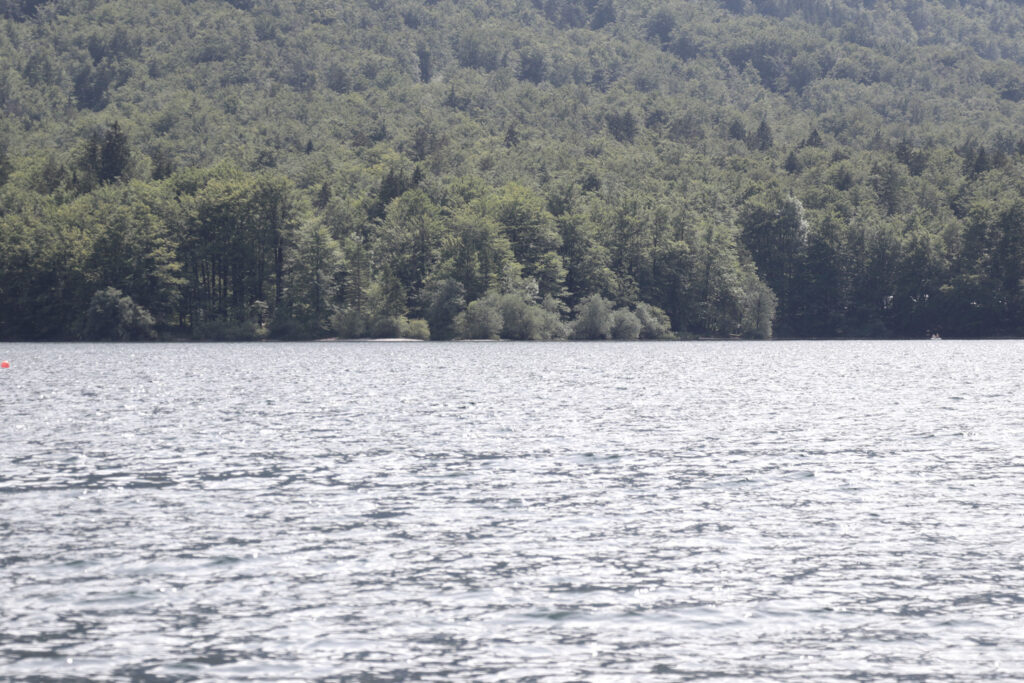
Bohinj
We leave the safe walls of the workspace. We step onto a gravel path that slowly leads us through a wheat landscape toward Lake Bohinj. The sun is strong, and every so often a cold gust of wind touches us, reminding us that within the valley still breathe the forces of the glacier that shaped this vast emptiness. We exchange glances, respectfully lift our gaze toward the mountains, and continue walking. Before us, the vastness of the lake gradually opens. We step onto a rocky shore, touch the cold water, and greet a few passing tourists hurrying toward the popular village. We continue in the opposite direction, into the heart of the great valley.
The path winds along the northern shore of the lake, where the shadows of trees dictate the rhythm of walking. The shimmering surface of the lake disappears and reappears, creating a gentle visual harmony. Time slows down, and nature becomes increasingly raw and expressive. We step over stones, hidden mountain streams, and the roots of mighty trees. Then, just as we believe nature has taken full control, a small wooden house quietly appears ahead. Our pace quickens with excitement. A few steps before the entrance, a void begins to open. We feel the energy of wind flowing from the high mountains on the other side of the lake. The rhythm dictated by the trees breaks, and the lake is no longer merely a scenic harmony. The void—framed by two large trees and a wooden house whose door is locked—invites us in and frames the view of the mountain wall beyond the water. We breathe deeply. We feel freedom. In the shelter of the bay, time stops completely, and the lake speaks quietly.
After a few hours spent in the bay, we continue along the path. Passing the wooden house, which is being slowly overtaken by nature on its other side, we ascend a few meters higher, where the forest again takes over and sets the rhythm of life. Soon another opening appears along the path, into which a lively stream flows over rocks. But there is no view now; the lake is almost invisible, hidden by trees. We notice a broken fence that once marked this passage and now invites us to step into the unknown. We leave the hardened path and step onto slippery rocks in the dark shade of trees. Branches entangle our clothes, and rays of light that manage to penetrate the dense canopy illuminate the rough textures of the ground. It feels as if the outside world has fallen completely silent. Our heartbeat quickens. “Should we continue? Is it safe? Why is this area fenced off?” we ask ourselves while carefully stepping forward.
Through dense vegetation, geometric forms begin to emerge, enclosed by a long wall. We stop. At the sight of concrete cylinders, a chill runs through us. “What is this structure?” we ask silently, each to ourselves.
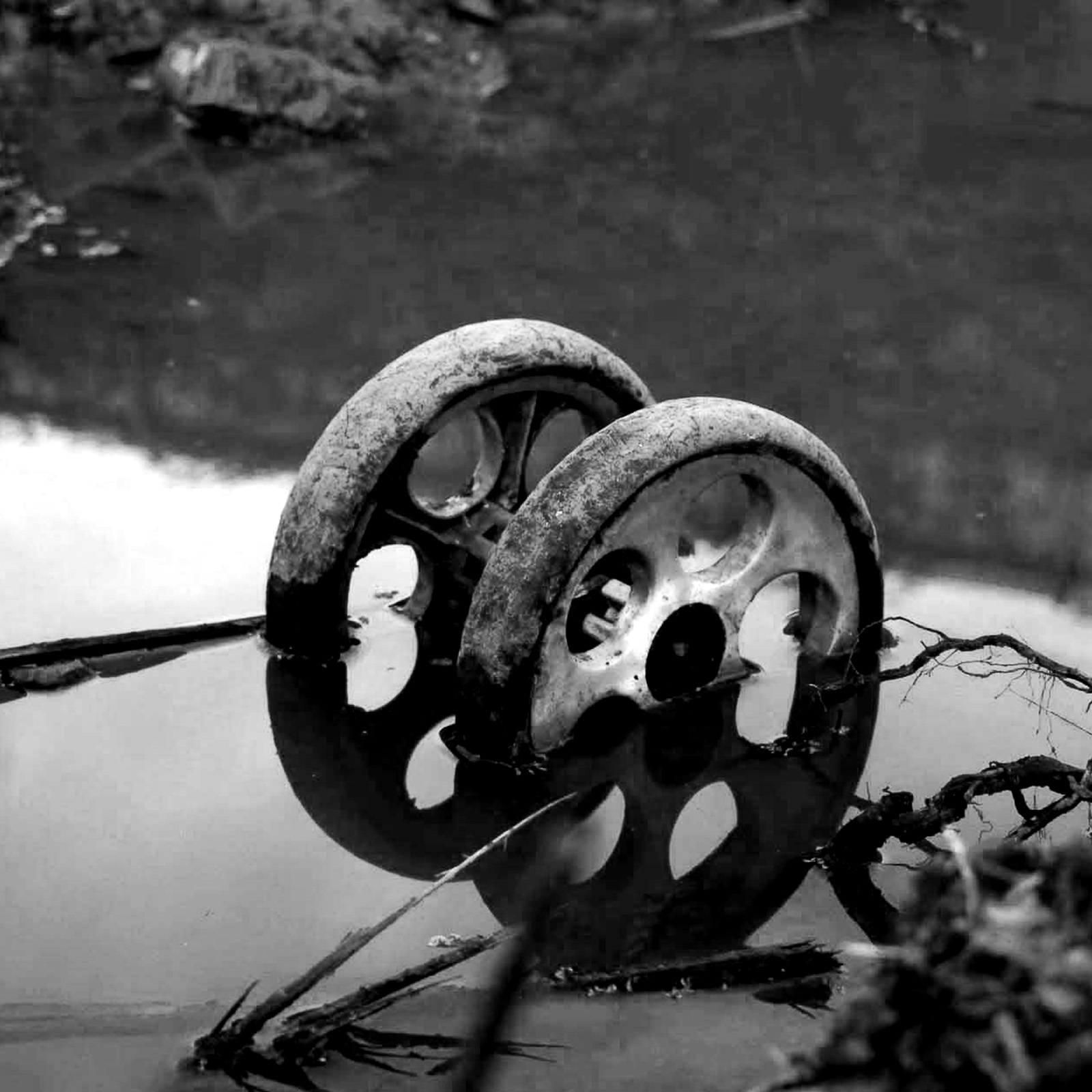
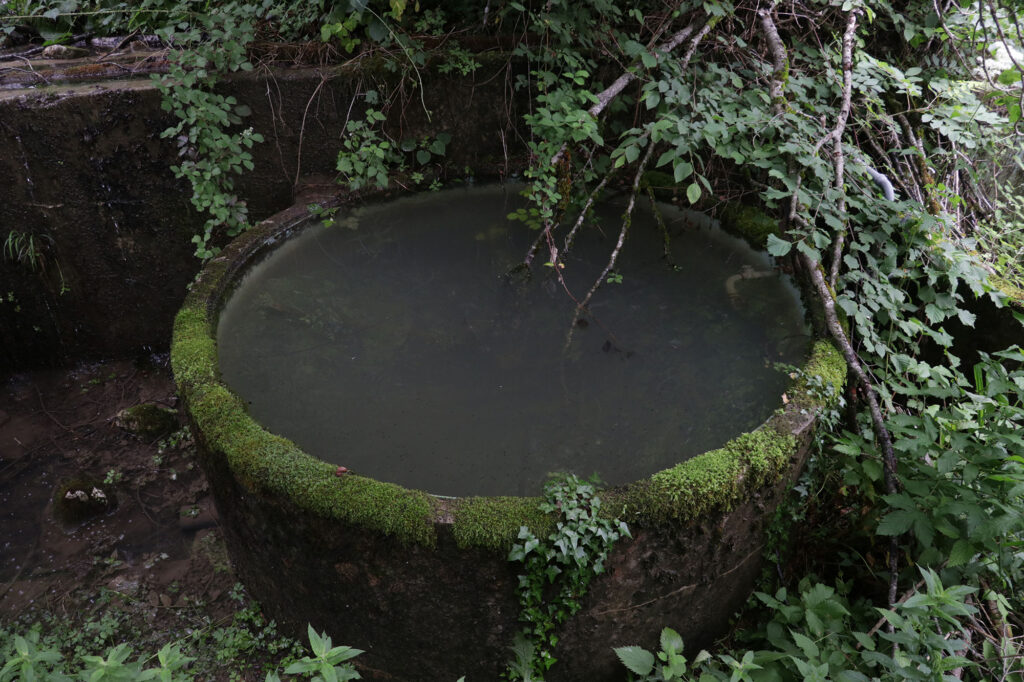
Carefully we step onto a concrete wall that, with its long gesture, defines a strong boundary between built intervention and elegant nature. We walk along it, balancing carefully as we push through vegetation. On one side lie concrete ruins in the form of hollow cylinders; on the other, beyond the trees, the surface of the vast lake. It feels as if the lake has fallen silent for a moment, and the ruins have begun to speak. Branches and roots penetrate concrete cracks, moss overgrows the edges of the wall, and inside the cylinders stagnant water hosts insects, flies, and beetles. It seems as though the structure is slowly dying in the embrace of nature.
From the safe shelter of the external world—where paths are orderly, houses carefully designed, gardens maintained, and experiences planned—we have stepped into a space that is rough, untamed, dark, and abandoned. A space we may even be ashamed of and push to the margins of our awareness. Yet it is precisely this that, despite fear and uncertainty, leads us forward.
The concrete ruin in the grip of nature is, in David W. Orr’s terms, a “laboratory of diversity and complexity.” Within it, human history and social functions intertwine directly with natural processes. The ruin is therefore not only a construct of the physical world but also a mirror of our own psyche.
We confront the darker side of humanity—decay. With our hands we try to push away thorny branches, with our feet we step across moss that covers the concrete wall. Our hearts drive blood rapidly through our veins, our breathing becomes faster. And then—silence. We look ahead and see something unusual. Before us stands a beautiful apple tree. In the middle of concrete ruins and wild nature, a tree lives without resistance. It is one with its environment, in coexistence. In that moment we forget ourselves. We surrender. We slow down and breathe deeply. The lake speaks again; between the canopies the sky opens; sunlight illuminates the edges of the concrete cylinders filled with water, where tadpoles swim. Life is being born.
Retrospective
I am still sitting on the wooden bench, remembering the past days and observing the harmony of nature. I realize what we actually experienced: birth, life, and death of a human intervention in nature. A beginning and an end. The ruin did not demand an answer. It only opened a question: should it become just another chapter in the story of this glacial landscape?
Bohinj became a space that we did not merely analyze passively, but within which we actively made sense of architectural practice. Being in space meant simultaneously seeing its past, present, and future. The focus shifted to the process of thinking itself—continuous attempting and interpreting. That was enough for this place to become conscious—both within an academic and educational environment, and within the broader local and social context.
The power of the concrete ruin, which quietly spoke in the midst of untouched nature, extends beyond its material presence. Its power lies in its resonance within us. This structure, slowly and dignifiedly dying in the embrace of the forest, is not there in vain. It has become a mirror of the soul and part of human consciousness.
Ultimately, it is deeply human to assign meaning to spaces and objects and to build stories around them. History teaches us that neither perfectly designed spaces nor the most carefully considered architecture survive. What survives is the space that carries a story.
Project Pedagogy of landscape
Author Žan Pirman
Type Retrospective essay
Year 2026
Published inOutsider.si